

Closing the gap takes more than adding more tests
Most QA teams want more automation. The harder question is how to scale it without creating more instability, maintenance, and disconnected work.
That is where mature QA teams operate differently.
They do not treat test automation as a one-time project or measure progress only by the number of scripts in a suite. They treat automation as a system that includes people, processes, tooling, test design, coverage, CI/CD integration, reporting, and ongoing improvement.
The test automation gap exists when the amount of testing a team wants or needs to automate exceeds what it can realistically automate with its current tools, skills, and capacity. As the previous article in this series explains, QA teams struggle to automate more testing when flaky tests, complex applications, fragmented tooling, skill gaps, and weak pipeline integration reinforce one another.
Closing that gap requires more than ambition. It requires a deliberate approach to how automation is planned, built, maintained, measured, and scaled.
The goal is not 100% automation. The goal is effective automation: automating the right tests, improving reliability, reducing repetitive manual regression work, and giving teams faster confidence in every release.
Start with automation maturity, not automation volume
A common mistake is assuming that more automated tests always means better automation.
A large suite can still slow a team down if its tests are flaky, difficult to maintain, poorly integrated, or disconnected from the workflows that carry the greatest risk. Test count shows activity, but it does not show whether automation is improving quality or delivery.
Instead of asking, “How many more tests can we automate?” mature teams ask:
- Which manual tests consume the most time during every release?
- Which workflows create the greatest business risk if they fail?
- Which automated tests are trusted, and which ones create noise?
- Where does maintenance prevent the team from expanding coverage?
- Which applications, platforms, or teams remain excluded from automation?
- Which tools help automation scale, and which ones create fragmentation?
This shifts the conversation from automation volume to automation impact.
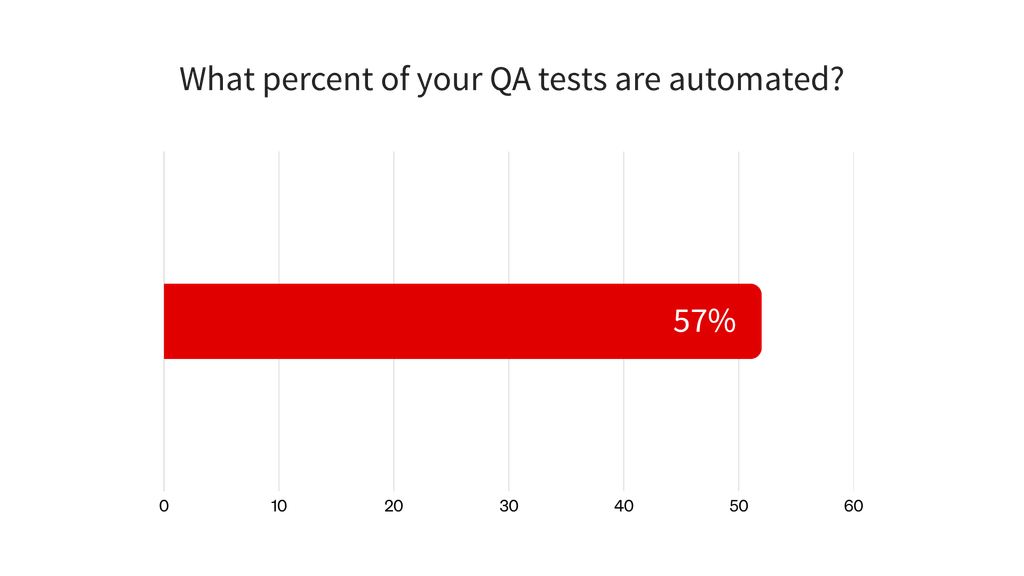
According to the 2026 Sembi Software Quality Pulse Report, teams automate 57% of QA tests on average. Many teams have therefore made meaningful progress, but 43% of testing remains manual.
The next stage of maturity is not simply automating the easiest remaining tests. It is closing the gap between what the team has automated and what it needs to automate to support faster, safer, and more reliable delivery.
Prioritize the tests that matter most
Mature QA teams do not try to automate everything at once. They prioritize tests based on risk, frequency, repeatability, business impact, and maintenance cost.
Strong candidates for automation often include:
- High-frequency regression tests
- Business-critical workflows
- Repetitive manual test cases
- Cross-browser or cross-platform scenarios
- Workflows validated before every release
- Tests that provide fast feedback to developers
- Scenarios where manual execution is slow or error-prone
Poor candidates may include one-time tests, low-value scenarios that rarely run, highly subjective evaluations, or tests whose maintenance cost would exceed their likely benefit.
Some testing should also remain human-led. Exploratory and usability testing depend heavily on judgment and context, while accessibility, security, and compliance testing often combine automated checks with expert review.
A risk-based testing approach helps teams identify where failure would have the greatest impact and direct automation toward those areas. This prevents teams from building impressive test counts while leaving their most consequential workflows under-tested.
Automation maturity is not about removing people from testing. It is about freeing testers from repetitive validation so they can focus on investigation, risk, and quality decisions that require human insight.
Reduce flakiness before expanding coverage
Flaky tests are one of the biggest barriers to automation maturity. If a test fails inconsistently, teams cannot use it as a dependable signal.
Developers may begin ignoring failures, QA teams may spend hours investigating false alarms, and release teams may return to manual validation because they do not trust the automated results.
Mature teams treat reliability as a prerequisite for scale. Before adding more tests, they identify where instability comes from and address the root cause.
Common practices include:
- Replacing fixed delays with explicit or condition-based waits
- Using stable selectors and dependable object identification
- Isolating tests so they do not depend on execution order or shared state
- Provisioning predictable test data and cleaning it up after execution
- Controlling environmental differences between local and pipeline runs
- Designing assertions around intended behavior rather than volatile implementation details
- Quarantining unstable tests while they are investigated
- Tracking repeated pass-and-fail patterns across test history
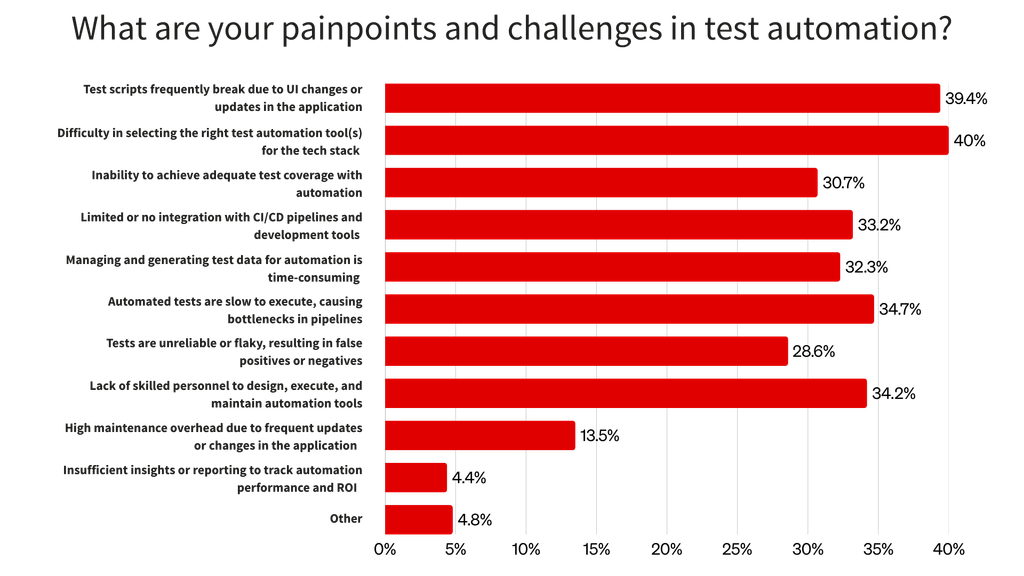
The Software Quality Pulse Report found that scripts breaking because of UI changes or application updates was the top reported automation challenge, cited by 39% of respondents. Another 29% cited flaky tests that create false positives or false negatives.
Ranorex’s guide to identifying and fixing flaky tests explains how timing, external dependencies, environments, shared state, and test design contribute to inconsistent outcomes.
Automation closes the gap only when teams can trust it. A smaller suite of reliable tests is more valuable than a larger suite that creates constant uncertainty.
Lower test maintenance overhead
Test maintenance is normal. Excessive maintenance is a warning sign.
Applications change, interfaces evolve, workflows shift, and integrations are updated. Automated tests must change with them, but the way those tests are designed determines whether each update requires one targeted fix or dozens of scattered changes.
Mature QA teams make maintenance more manageable by:
- Building reusable test components
- Standardizing test names, structure, and ownership
- Maintaining shared object repositories or reusable modules
- Separating test logic from volatile UI details
- Keeping test data and environment setup repeatable
- Documenting common automation patterns
- Reviewing failures for root causes instead of repeatedly rerunning tests
- Retiring tests that no longer protect meaningful behavior
- Tracking maintenance effort as an automation metric
The goal is not to eliminate maintenance. It is to prevent maintenance from consuming the capacity needed to expand automation.
For example, if several tests use the same login or checkout component, that interaction should be maintained in one reusable module rather than copied into every script. A selector or workflow change can then be corrected once instead of across the entire suite.
Ranorex’s guidance on building maintainable tests explains how test design, reuse, and consistent structure reduce long-term upkeep.
When maintenance becomes predictable, teams can stabilize their foundation and create room for new coverage.
Connect fragmented testing and tooling
Many teams struggle to scale automation because their testing process is fragmented.
Manual tests may live in one system, automated scripts in another, and results across CI/CD tools, dashboards, spreadsheets, and team-specific workflows. Teams may also use different frameworks, naming conventions, ownership rules, and reporting methods.
Mature QA teams work to connect these pieces. They establish a shared process for how tests are designed, organized, executed, reported, and maintained.
Fragmentation often causes:
- Manual and automated testing to be tracked separately
- Results to be scattered across systems
- Limited visibility into coverage and risk
- Duplicate automation across teams
- Inconsistent quality metrics
- Difficulty connecting results to releases
- Limited ability to measure automation ROI
Automation does not scale through scripts alone. It scales through visibility, governance, reuse, consistent standards, and dependable execution.
A scalable test automation strategy should define ownership, shared components, reporting standards, integration points, and the criteria used to decide which tests run where.
This gives QA leaders a clearer view of what is covered, what is failing, where risk remains, and what the team should automate next.
Integrate automation into CI/CD
Test automation creates the most value when it provides fast, relevant feedback.
If automated tests are disconnected from the delivery pipeline, teams may not discover problems until code has been merged or a release has entered late-stage validation. At that point, the change that caused the failure is harder to identify and more expensive to fix.
Mature teams integrate automation into CI/CD so appropriate tests run with code changes, builds, deployments, and release candidates.
The Software Quality Pulse Report found that 86% of teams with strong automation and CI/CD integration experienced faster release cycles, while 71% reported reduced defect leakage. These results show why pipeline integration is an important marker of automation maturity.
CI/CD integration does not mean every test should run after every commit. Mature teams use layers:
- Fast unit and component tests run early and frequently.
- Targeted integration tests validate affected services and dependencies.
- Smoke tests confirm that critical workflows still function.
- Broader regression suites run at appropriate build or release stages.
- Longer end-to-end tests run when they provide useful coverage without blocking faster feedback.
This structure gives developers quick results while preserving broader validation at the right points in the delivery process.
Effective CI/CD test automation provides the right feedback at the right time instead of creating another slow or noisy pipeline stage.
Balance low-code and full-code automation
Automation maturity depends on both accessibility and flexibility.
If every automation task requires advanced coding skills, too few people may be able to contribute. If the team’s tools support only basic low-code workflows, automation engineers may not have the control needed for custom logic, complex data, and advanced integrations.
Mature teams often need both approaches.
Low-code capabilities can help manual testers, QA analysts, and subject-matter experts contribute their product knowledge directly to automation. Full-code capabilities give automation engineers and SDETs control over advanced logic, reusable architecture, custom integrations, and debugging.
This balance is especially important for teams testing complex applications across desktop, web, and mobile environments. A mature strategy should make automation accessible to more contributors without limiting what technical users can build.
Ranorex’s guide to automated UI testing explains how teams can combine visual test creation with deeper customization as their needs grow.
Expand coverage into complex workflows
The automation gap often persists because teams automate the easiest tests first while difficult workflows remain manual.
That can create a false sense of maturity. A suite may contain hundreds of automated tests while still relying on manual validation for the business processes that matter most.
Mature QA teams look directly at the hard-to-automate areas:
- Which business-critical workflows are still manual?
- Which application types remain under-automated?
- Which desktop, web, or mobile scenarios lack coverage?
- Which workflows are too brittle for the current approach?
- Which tests fail because object identification is unreliable?
- Which end-to-end processes span several systems or integrations?
- Which scenarios depend on complex data or permissions?
The team can then evaluate feasibility using representative workflows rather than assuming that success with simple tests will extend to every part of the application.
This is where automation maturity moves from basic coverage to meaningful coverage. The goal is not to achieve the highest possible test count. It is to automate workflows that protect the business, reduce repetitive effort, and improve release confidence.
Measure automation impact, not just activity
Mature QA teams measure automation by the outcomes it creates.
Test count remains useful, but it does not show whether automation is reliable, efficient, or aligned with business risk. Better metrics include:
- Percentage of high-risk regression coverage automated
- Manual testing hours saved per release
- Flaky test rate
- Test maintenance effort
- Defect leakage
- Release delays caused by testing
- CI/CD test execution time
- Time from code change to test feedback
- Reuse of automation components across teams
- Visibility across manual and automated coverage
Teams can also measure automation ROI by comparing the time and cost saved through automated execution with the cost of tools, infrastructure, implementation, and maintenance.
Ranorex’s guide to test automation ROI explains why maintenance, execution frequency, defect detection, and manual hours saved all belong in that calculation.
Outcome-based measurement helps QA leaders connect automation work to results the business understands: faster releases, lower risk, greater confidence, and more efficient use of team capacity.
Create a roadmap to close the gap
Mature QA teams close the test automation gap through steady, focused improvement.
1. Assess current maturity
Document current automation coverage, manual regression effort, flaky test rate, maintenance workload, CI/CD integration, tooling fragmentation, skills, and visibility gaps.
2. Stabilize what already exists
Fix, quarantine, or retire flaky tests. Improve test isolation, selectors, synchronization, reusable components, data setup, and reporting before adding more volume.
3. Expand coverage where it matters most
Prioritize high-risk, high-frequency, and business-critical workflows. Focus on tests that reduce repetitive effort and increase release confidence.
4. Scale through connected tools and processes
Integrate automation into CI/CD, establish shared standards, connect results, define ownership, and make automation components easier to reuse across teams.
5. Measure and adjust
Track reliability, maintenance, feedback speed, coverage, and business outcomes. Use those findings to decide what to stabilize, automate, or retire next.
This roadmap moves teams from isolated automation activity to a scalable quality process.
What mature QA teams do differently
Mature QA teams close the test automation gap by changing how they think about automation.
They do not chase automation for its own sake. They focus on dependable coverage, connected workflows, practical scalability, and measurable impact. They automate tests that reflect business risk, reduce flakiness before expanding coverage, control maintenance, integrate testing into delivery pipelines, and support contributors with different levels of technical expertise.
Most importantly, they recognize that the test automation gap is not just a tooling problem. It is a maturity problem involving people, process, architecture, and measurement.
That foundation becomes even more important as AI increases the pace and volume of software change. Mature teams turn automation from a collection of scripts into a connected and trusted quality system.
The final article in this series explains why Ranorex is built for complex, reliable test automation, including how its object recognition, cross-platform coverage, low-code and full-code flexibility, integrations, and deployment options support mature QA teams.
Take the Test Automation Maturity Assessment to see where your team stands and identify the next steps for improving automation coverage, reliability, and scale.
Explore the test automation gap series
- What Is the Test Automation Gap and What Is It Costing Your Team?
- Why QA Teams Struggle to Automate More of Their Testing
- Why Ranorex Is Built for Complex, Reliable Test Automation
FAQ
How do mature QA teams close the test automation gap?
Mature QA teams close the test automation gap by prioritizing high-value tests, reducing flakiness, lowering maintenance overhead, connecting fragmented tools, integrating automation into CI/CD, and measuring automation impact.
What tests should QA teams automate first?
QA teams should usually start with high-frequency, high-risk, repeatable tests that are time-consuming to run manually and important to release confidence.
Why is test reliability important for automation maturity?
Test reliability is important because teams need to trust automation results. Flaky tests create noise, slow down triage, and often push teams back toward manual validation.
How can QA teams reduce test maintenance?
QA teams can reduce test maintenance by using stable selectors, reusable components, shared object repositories, clean test environments, consistent standards, and regular test suite reviews.
Why does fragmented tooling make automation harder to scale?
Fragmented tooling makes it harder to connect manual and automated testing, consolidate results, measure coverage, reuse automation assets, and understand quality risk across teams.
Is 100% test automation the goal?
No. The goal is not to automate every test. The goal is to automate the right tests in a reliable, maintainable, and scalable way while preserving human-led testing where judgment and creativity are needed.